Country dossier
Living in the UAE as a Muslim: Visas, Costs, Schools and Halal Life
Residence routes, cost pointers, Islamic education in schools, Friday prayer, Ramadan hours, halal marks, health cover and FCDO advice for Muslims in the UAE.
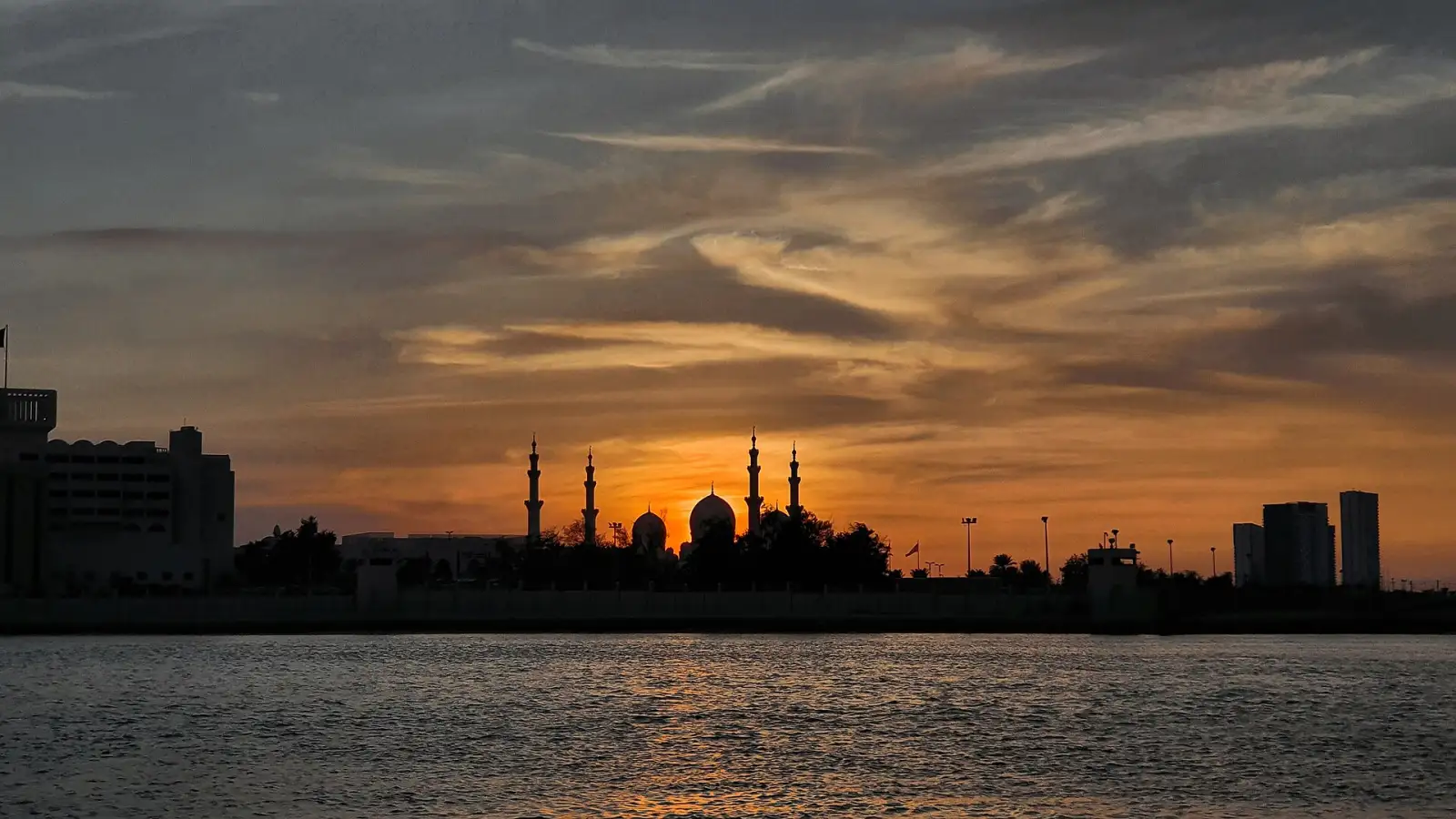
Photo: PotatoWitch, CC BY-SA 4.0, Wikimedia Commons
At a glance
- Golden visa (investor)
- Capital of at least AED 2 million (about USD 545,000); 10 years for public investments, 5 years for real estate
- Ramadan working hours
- Private-sector hours reduced by two hours a day (MoHRE announcement, 12 Feb 2026)
- Islamic Studies in schools
- Compulsory for Muslim pupils, Grades 1 to 12; non-Muslims exempt
- Health insurance (Dubai)
- Mandatory under Law No. 11 of 2013; employers cover staff, sponsors cover dependents
The United Arab Emirates is a federation of seven emirates, and rules on schools, health cover and property can differ between Dubai, Abu Dhabi and the others. This page brings together what the official portals say about residence routes, daily life and the practical side of Muslim life there, with the date each source was read. It is information, not advice: nothing here tells you which visa to apply for.
Safety first: read the current advice
Before anything else, read the latest official travel advice. The UK Foreign, Commonwealth and Development Office (FCDO) page for the UAE, read on 12 November 2026, shows no formal “advise against” level but carries a “regional tensions” warning. It describes the situation as “deeply unpredictable”, says the risk of sudden escalation is high and notes that flights and airspace can change at short notice. It does not name UAE regions to avoid beyond areas around security or military facilities. Its last update was on 27 October 2026. The FCDO advice also tells residents to follow local authority guidance, to know where the nearest shelter is, and never to touch fragments of drones or missiles.
The US State Department also publishes an advisory for the UAE. The versions we could read showed Level 3, “Reconsider travel”, citing armed conflict and terrorism, but the page versions carried different dates and we could not open the live page today, so check travel.state.gov directly. Families should weigh these notices for themselves; this site does not judge any country.
Residence routes at a glance
The UAE offers several residence routes. The summary below is taken from official pages read on 12 November 2026. Amounts and conditions change, so use the linked portals, and consider a professional review before any application.
| Route | Validity | Headline condition as published | Official page |
|---|---|---|---|
| Golden visa, investor (public investment) | 10 years | Capital of at least AED 2 million (about USD 545,000) | u.ae |
| Golden visa, investor (real estate) | 5 years | Capital of at least AED 2 million | u.ae |
| Golden visa, exceptional talent | 10 years | No AED figure; category-specific documents | u.ae |
| Green visa, skilled employee | 5 years | Salary of at least AED 15,000 a month, bachelor’s degree, MoHRE skill level 1 to 3 | ADRO |
| Retirement visa | 5 years | Age 55 or over, 15 years of work, plus a financial condition | u.ae |
| Employment residence | Employer-sponsored | Work permit, entry permit, medical test, Emirates ID | u.ae |
AED figures convert to USD at the central bank’s fixed rate of 3.6725 per dollar, as published in its exchange rate table of 1 September 2026.
Golden visa
The u.ae Golden visa page lists investors, entrepreneurs, people with exceptional talent or rare specialisations, outstanding students, and humanitarian pioneers and frontline workers. Only the investor category carries an AED threshold on that page: a minimum capital of AED 2 million, through property ownership or a contribution to an establishment that pays at least AED 250,000 a year in taxes. Public investments are listed at 10 years and real estate at 5 years. The page says holders can sponsor family members, including spouses and children, but it does not set out the conditions. Other sites report extra conditions such as how mortgaged property is treated; those are secondary sources and we have left them out.
Green visa
The Abu Dhabi Residents Office page for the skilled-employee category states five years of validity, a monthly salary of at least AED 15,000 or the foreign-currency equivalent, a work permit based on a UAE employment contract, a position at MoHRE level one, two or three, and a bachelor’s degree or equivalent. The page also states that nomination requests for this category through the Abu Dhabi Residents Office were currently unavailable when we read it. We did not find an official page we could read for the freelancer green visa threshold, so no figure is given.
Retirement visa
Per the u.ae page, the retirement visa is a five-year long-term visa. Applicants must be at least 55 at the time of retirement and have worked at least 15 years, inside or outside the UAE. The financial condition is one of two: property worth at least AED 1 million together with savings of at least AED 1 million, or an annual income of at least AED 180,000. Applicants in Dubai must show a fixed annual income of at least AED 240,000. No fees are listed on that page.
Employment residence
Most residents arrive through an employer. The u.ae guidance describes a sequence: a job offer on the standard MoHRE contract, a work permit, an entry permit, a medical fitness test and an Emirates ID, after which the residence visa is issued. The summaries we read give the entry permit as valid for two months and the residence visa for two years, and say the law places the cost of the entry visa and residence issuance on the employer. Working without a valid MoHRE work permit is not allowed.
Cost of living: headline figures
There is no single UAE price level, since Dubai, Abu Dhabi and Sharjah differ. Three sourced pointers:
- Inflation. Dubai’s consumer price index was reported at 5.3% year on year in July 2026 by MEED, which cites Dubai Statistics Center data; housing and utilities were the largest contributor.
- Basket weight. The National reported on 26 May 2026 that housing and utilities make up 37.6% of the Dubai basket, the largest component, and linked the 2026 price rise in fuel and food to the conflict affecting the Strait of Hormuz.
- Public transport. The RTA fare table lists a Silver nol card single trip at AED 3 within one zone, AED 5 across two adjacent zones and AED 7.50 across more than two, and a 30-day all-zone Silver pass at AED 350 (about USD 95).
For a line-by-line family budget with sources, see the Dubai cost of living guide.
Schools and Islamic education
Education is regulated by emirate: KHDA in Dubai, ADEK in Abu Dhabi, with the federal Ministry of Education setting national mandatory subjects. The u.ae portal describes private schools following the national subjects alongside their own curriculum.
On Islamic education, Khaleej Times reported on 2 September 2022 that the Ministry’s policy was unchanged: all private schools must teach the Ministry’s Islamic Studies curriculum from Grade 1 to Grade 12, the subject is mandatory for Muslim students and non-Muslim students are exempt. It added that British-curriculum schools start the subject in Grade 2 while American and Emirati-curriculum schools start in Grade 1. This is a press report of the policy rather than the policy text, so confirm with the school you are considering.
In Abu Dhabi, ADEK’s July 2025 subjects policy for kindergarten makes Arabic mandatory from Pre-KG, and places Muslim children in Islamic Studies from KG1 in the streams it describes. It says Islamic Studies is recommended but not mandatory at Pre-KG. In Dubai, KHDA has updated its requirements for the mandatory national subjects, including Arabic and Islamic Education, from Grade 1 to Grade 12.
For fees, Khaleej Times reported that KHDA confirmed Dubai private-school fees would stay unchanged in 2026-27, and that the 23 schools rated Outstanding charge between AED 29,488 and AED 111,799 a year depending on school and grade. These figures cover Outstanding schools only. We have not found an official all-school fee table.
Mosques, Friday prayer and the working week
On 1 January 2022 the federal government moved to a four-and-a-half-day week with a Saturday and Sunday weekend, as NPR reported; Friday became a half day for federal staff. Private employers have their own flexibility, and Sharjah’s government uses a different pattern, with a Friday-to-Sunday weekend for its employees.
Friday prayer times moved with the change. Gulf News reported in December 2021 that Friday prayers and sermons would be held after 1.15pm from January 2022. A later report by Scene Now says the General Authority of Islamic Affairs, Endowments and Zakat set a unified time of 12.45pm from 2 January 2026. Because we could only read secondary reports of the 2026 change, check the time with your mosque. Sharjah mosques kept an earlier time in 2022.
During Ramadan, MoHRE’s announcement of 12 February 2026 reduces normal private-sector working hours by two hours a day, in implementation of Federal Decree-Law No. 33 of 2021. Companies may use flexible or remote work within the reduced hours.
Halal food
The Halal National Mark is the first halal mark introduced by the Ministry of Industry and Advanced Technology (MoIAT), issued by its Department of Conformity to a product, a service or a production system once it conforms to the approved standards. The page describes the mark as optional, while also saying that products and services wishing to emphasise Sharia compliance are required to obtain certification. A 2022 infographic on the same page counts 7,585 marks issued, 6,581 for food and 1,004 for cosmetics and personal care. When shopping, look for the mark and ask the retailer for the certificate if you are unsure.
Healthcare
Health cover is a legal requirement in the main emirates. The Government of Dubai states that under Law No. 11 of 2013 health insurance is mandatory in Dubai: employers must provide coverage for employees, including those in free zones, and sponsors must extend coverage to spouses, children and domestic workers. Abu Dhabi’s rules sit with its Department of Health and also place the duty on employers and sponsors. Proof of valid health insurance is among the documents typically needed for a residence visa. We do not rate or recommend any insurance product.
Family law: what is sourced
The UAE applies different personal-status rules depending on religion. For non-Muslim residents, Federal Decree-Law No. 41 of 2022 on civil personal status covers marriage, divorce, inheritance and wills, and the u.ae page describes civil marriage as a court-registered contract without religious rites, which Muslims cannot use. Muslim residents are covered by the UAE personal-status law rather than that decree; we do not summarise its content here because we have not read the official text. Questions on marriage, custody or inheritance belong with a qualified UAE lawyer.
Your first 90 days: a checklist of official steps
This list reflects procedure as published, not personal advice.
- Before travel. If you are employed, your employer arranges the work permit and entry permit. Check the FCDO advice again before booking.
- Within the entry-permit window. Complete the medical fitness test and apply for the Emirates ID.
- Within about one month of arrival. Finalise the residence visa; keep your health insurance proof ready.
- Housing. In Dubai, tenancy contracts are registered through Ejari and rent increases at renewal are capped by the Dubai Land Department’s rent index; see the Dubai guide.
- Schools. Check each school’s KHDA or ADEK rating and fee page, and ask how Islamic Studies and Arabic are timetabled.
- Community. Learn your local mosque’s Friday time, and your employer’s Ramadan hours.
For comparison with other destinations, see Malaysia or the ranking page, which explains why any ranking depends on the criterion you pick. Scholarly questions about migration itself are covered in Making hijrah.
Frequently asked questions
Is the UAE a good place to live as a Muslim?
That depends on your own criteria, so this page lists facts rather than a verdict. Muslim residents find a Friday prayer, a halal national mark, compulsory Islamic Studies in schools and reduced Ramadan working hours in the private sector. Against that, the cost of housing is high and the regional security situation is a live factor, which is covered in the safety section.
What is the weekend in the UAE and when is Friday prayer?
Since 1 January 2022 the federal government works Monday to Thursday plus a half day on Friday, with a Saturday and Sunday weekend; private employers choose their own pattern. Friday prayers were moved to after 1.15pm in 2022, and a January 2026 report says the unified time is now 12.45pm. Confirm the time with your local mosque or the General Authority of Islamic Affairs, Endowments and Zakat.
Is Islamic education compulsory in UAE schools?
Yes for Muslim pupils. The Ministry of Education policy, as reported by Khaleej Times in 2022, requires private schools of every curriculum to teach Islamic Studies from Grade 1 to Grade 12, and non-Muslim pupils are exempt. Schools in Abu Dhabi follow ADEK's subjects policy, and Dubai's KHDA applies the national mandatory subjects too.
Do working hours drop during Ramadan in the UAE?
For the private sector, the Ministry of Human Resources and Emiratisation announced on 12 February 2026 that normal working hours are reduced by two hours a day during Ramadan. Employers may use flexible or remote arrangements within those limits. Government entities set their own Ramadan timetable.
Is health insurance compulsory in the UAE?
In Dubai, Law No. 11 of 2013 makes health insurance mandatory: employers must cover employees, including in free zones, and sponsors must cover dependents. Abu Dhabi has its own rules through its Department of Health, which also place the duty on employers and sponsors. This is a statement of the rule only, not a recommendation of any product.
How do I know food in the UAE is halal?
The Ministry of Industry and Advanced Technology issues the Halal National Mark for products, services and production systems after checking conformity with approved standards. Its page calls the mark optional but says anyone who wants to stress Sharia compliance is required to get certified.
Sources
- UAE Government portal: Golden visa — read on 12 November 2026
- UAE Government portal: Residence visa for the retired — read on 12 November 2026
- Abu Dhabi Residents Office: Green visa, skilled employees — read on 12 November 2026
- UAE Government portal: Preparing to work — read on 12 November 2026
- MoHRE: Ramadan working hours 2026 — read on 12 November 2026
- NPR: UAE adopts a 4.5-day work week (Dec 2021) — read on 12 November 2026
- Gulf News: Friday prayers after 1.15pm (Dec 2021) — read on 12 November 2026
- Scene Now: unified Friday prayer times from January 2026 — read on 12 November 2026
- Khaleej Times: Islamic Studies policy in schools (2 Sep 2022) — read on 12 November 2026
- KHDA: mandatory subjects update (2025) — read on 12 November 2026
- ADEK: KG and Ministry of Education subjects policy (July 2025) — read on 12 November 2026
- UAE Government portal: Private schools in the UAE — read on 12 November 2026
- Ministry of Industry and Advanced Technology: Halal — read on 12 November 2026
- Government of Dubai: Health insurance — read on 12 November 2026
- UK FCDO: UAE travel advice — read on 12 November 2026
- UAE Government portal: Civil marriage (non-Muslims) — read on 12 November 2026
- RTA: nol fares — read on 12 November 2026
- Khaleej Times: Dubai school fees 2026-27 — read on 12 November 2026
- The National: Dubai inflation (26 May 2026) — read on 12 November 2026
- Central Bank of the UAE: exchange rate table, September 2026 — read on 12 November 2026
Spotted an error or an outdated rule? See our corrections policy. Corrections
Read next
 Cost of living
 in Dubai: a family budget from official sources
A sourced monthly budget for a family of four in Dubai: nol fares, DEWA tariff, KHDA school fee ranges, rent-cap rules and CPI, in AED and USD, with gaps stated.
 Rankings
Best Muslim countries to live in: 14 compared on criteria you choose
Compare 14 Muslim-majority countries on sourced criteria: Muslim share, peace index, price level, income, English, long-stay routes and UK travel advice.
 Visas and settling in
Making hijrah: a practical 12-step roadmap
A practical 12-step plan for relocating to a Muslim-majority country: goals, budget, destination, documents, residence, income, schools, timeline.
The Hijrapass briefing
When a rule or a figure changes, you will know.
New dossiers, updated visas and cost figures, and what moved in our rankings: one short briefing, no noise.
The email briefing opens once our privacy notice is reviewed. RSS carries every update today.